
October Update: Two New Journals Take Shape



We are pleased to share another update on IUASP's new journal initiative. Following the progress made with our first three journals in September, two more journals have reached an important milestone this October: Pharmaceutical Sciences and Modeling and Flexible and Wearable Electronics have now confirmed their titles, founding Editors-in-Chief, and aims and scope.
These two journals mark the latest progress in IUASP's efforts to develop journal projects across different research fields. We are delighted to welcome Prof. Panos E. Macheras and Prof. William W. Yu as founding Editors-in-Chief. Their expertise will be instrumental in shaping the journals' scopes. We thank both professors for their trust in IUASP and their commitment to these new initiatives, and we look forward to working closely with them as preparations continue.
Two New Journals
Here, we introduce the research focuses of our two new journals and their founding Editors-in-Chief.

Pharmaceutical Sciences and Modeling is dedicated to publishing model-informed research across the drug life cycle, from molecular discovery to clinical application and market translation. The journal seeks to bring together perspectives from academic research, industrial practice, and regulatory science. Its scope includes ADMET modeling and molecular docking in drug discovery; drug dissolution and uptake, physiologically based pharmacokinetics (PBPK), bioavailability, and biowaivers in preclinical development; and pharmacokinetics (PK), bioequivalence (BE), pharmacodynamics (PD), exposure–response studies, population PK-PD, biosimilars, and monoclonal antibodies in clinical research. The journal also welcomes research on advanced applications across the drug life cycle, including dynamic systems analysis, artificial intelligence (AI) methods, and finite absorption time (F.A.T.) theory.
As the journal's founding Editor-in-Chief, Prof. Macheras strongly supports IUASP's commitment to decommercialization and its reviewer reward mechanism. Drawing on more than 30 years of experience in editorial board service and peer review, he recognizes the importance of tangible recognition for reviewers' contributions and sees IUASP's approach as a meaningful way to recognize these contributions. For the journal's future development, Prof. Macheras hopes to establish a leading platform for advancing Model-Informed Drug Development (MIDD), with a particular emphasis on research into and applications of his Finite Absorption Time (F.A.T.) theory. He envisions this research direction becoming a defining feature of the journal.
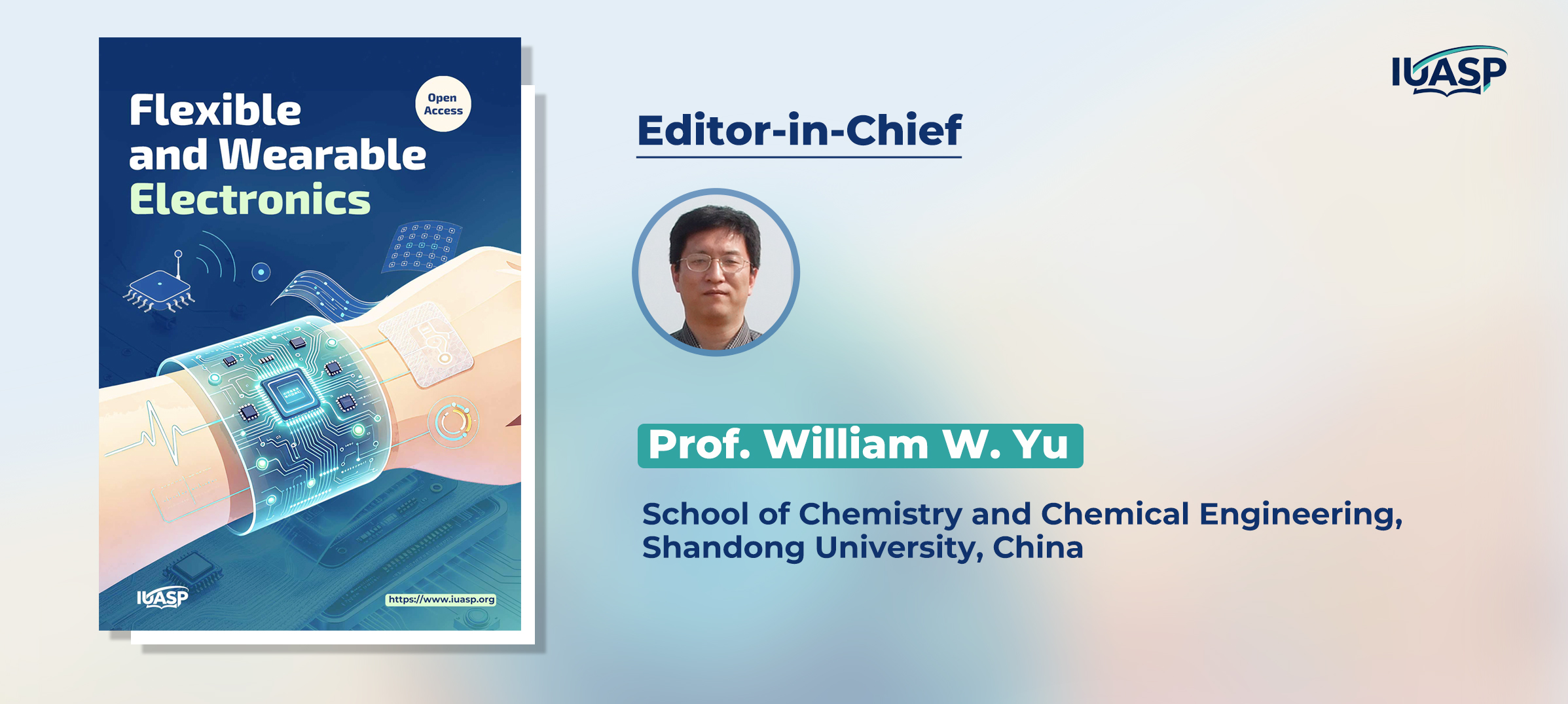
Flexible and Wearable Electronics is dedicated to publishing fundamental and applied research on materials, devices, and systems for electronics that can bend, stretch, conform to different surfaces, or interface with humans, robots, dynamic machines and objects, animals, plants, and fruits. The journal focuses on how material structures, processing methods, and interface properties influence electronic, optoelectronic, and sensing performance under mechanical deformation and in wearable applications.
Its scope includes functional polymers, nanomaterials, and hybrid composites for flexible electronics; flexible and stretchable electronic and optoelectronic devices, displays, lighting, and electrochromic devices; electronic skin, smart textiles, and wearable physical, chemical, and biological sensors; bioelectronics and human–machine interfaces; flexible energy harvesting, conversion, and storage; and related fabrication methods, interface engineering, encapsulation, and system integration. The journal also welcomes research on solution-processable nanomaterials, including quantum dots, metal nanoclusters, and magnetic nanomaterials, particularly studies of how controlled synthesis and growth enable flexible and wearable functions for applications in energy, healthcare, and environmental monitoring. Contributions may range from materials synthesis and mechanistic studies to device engineering and application demonstrations. Materials-focused research is welcome when it provides a clear foundation for flexible or wearable technologies; a complete device or wearable system is not required.
Looking Ahead Together
With five journals now taking shape, IUASP's portfolio of journals spans acute medicine, nanobiotechnology, translational brain science, pharmaceutical sciences and modeling, and flexible and wearable electronics. These fields reflect our ongoing exploration of research areas across the life sciences, medicine, materials science, and electronics. At the same time, we continue to develop ideas for journals in other fields and engage with scholars to explore additional research directions.
If you are interested in leading a new journal as its founding Editor-in-Chief or joining the editorial board of one of our five journals in development, we welcome you to get in touch. You can also submit a journal idea directly through our New Journal Proposal page. An idea does not need to be fully developed before a conversation begins. Whether you have an initial idea for an emerging research field or would like to explore an interdisciplinary area, we welcome the opportunity to discuss it with you. We look forward to hearing from scholars across disciplines and exploring how these ideas might take shape.
To learn more about IUASP's first three journals, read our earlier update:
One Month In: IUASP's First Three Journals Take Shape →
To learn more about the journal fields IUASP is exploring and our broader vision for academic publishing, read:
IUASP Invites Academic Leaders to Build and Lead New Journals →
Discussion (0)

No comments yet. Be the first to comment!